5–300 Nm³/h · Produces 75% H₂ + 25% N₂ from liquid NH₃ · Ni-catalyst at 800–850°C · Ideal protective and reducing atmosphere for metal heat treatment
Get a Quote & Technical Specs →| Model | Small Cracker | Standard Cracker | Industrial Cracker |
|---|---|---|---|
| NH₃ Consumption | 5 kg/h | 10–30 kg/h | 30–100 kg/h |
| Gas Output | 5–15 Nm³/h | 15–100 Nm³/h | 100–300 Nm³/h |
| Power | 6 kW | 18 kW | 45 kW |
| NH₃ Conversion | >99.9% (residual NH₃ <5 ppm with optional adsorber) | ||
| Catalyst Type | Nickel-based · Life: 3–5 years · Easy replacement design | ||
| Temperature Control | PID ±1°C · Multi-zone heating · Operating range: 800–850°C | ||
| Dimensions (L×W×H) | 800×600×1,500mm | 1,200×900×1,800mm | 1,800×1,200×2,200mm |
| Certifications | CE · ISO 9001 · Pressure vessel certification optional | ||
Step 1 — Vaporization: Liquid ammonia (NH₃) from a storage tank is vaporized and preheated to ~650°C in a heat exchanger.
Step 2 — Cracking Reaction: Preheated NH₃ passes through a nickel catalyst bed at 800–850°C, where it decomposes: 2NH₃ → N₂ + 3H₂
Step 3 — Cooling & Delivery: The hot mixed gas (75% H₂ + 25% N₂) is cooled and delivered to your process at the required pressure.
Step 4 — Purification (Optional): A molecular sieve adsorber removes residual NH₃ to <5 ppm for sensitive applications like semiconductor processing.
Cost Advantage: Liquid ammonia is significantly cheaper than bottled H₂/N₂ mixtures — typically 50–65% cost reduction for heat treatment atmospheres.
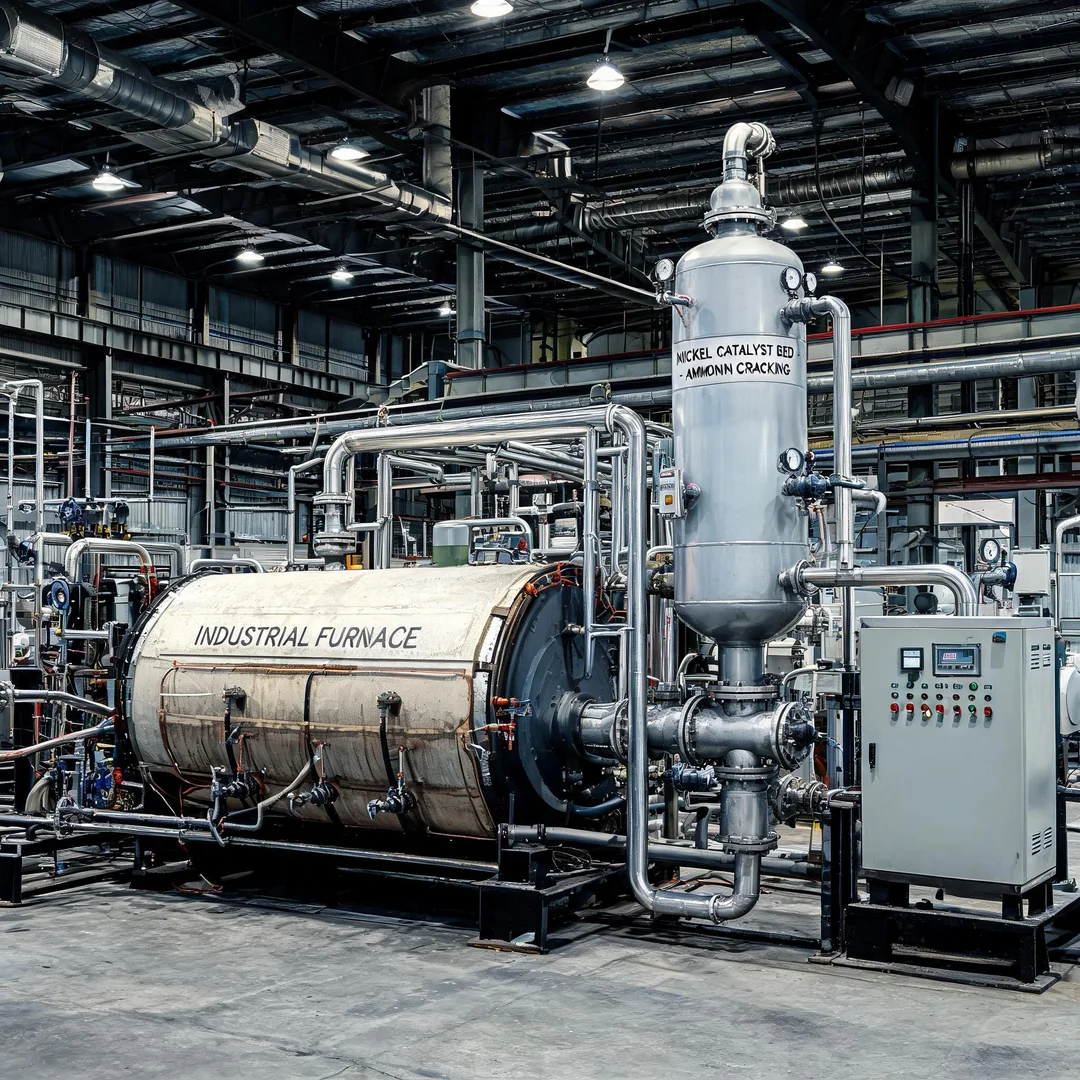
Bright annealing, sintering, brazing. H₂+N₂ protective atmosphere prevents oxidation at high temperatures.
View SolutionForming gas (H₂+N₂) for wafer annealing. Ultra-low residual NH₃ with downstream purifier.
View SolutionReducing atmosphere for catalyst activation, chemical vapor deposition, powder metallurgy.
View SolutionNickel catalyst ensures nearly complete decomposition. Residual NH₃ <5 ppm with optional purification.
±1°C temperature accuracy across multi-zone heating elements. Uniform cracking, consistent gas quality.
vs. buying H₂ and N₂ separately in cylinders. Liquid ammonia is abundant and economical.
Modular catalyst bed design. 3–5 year lifespan. Replacement takes <4 hours.
NH₃ leak detection, flame arrestor, emergency shutdown, pressure relief valves — standard equipment.
CE · ISO 9001. Pressure vessel certification available. Documentation for customs clearance.
Multi-zone electric heating with insulation. Rated for continuous 24/7 operation.
Twin beds for continuous operation. One in service, one on standby for seamless catalyst replacement.
Touchscreen HMI. NH₃ flow control, temperature monitoring, auto shutdown on alarm conditions.
Electric or steam-heated. Ensures complete vaporization before catalyst entry.
Molecular sieve bed for residual NH₃ removal to <5 ppm. Required for semiconductor UHP applications.
P&ID, electrical schematic, safety data sheets, CE certificate, 12-month warranty.
Often paired with ammonia crackers for complete H₂+N₂ atmosphere systems.
Remove residual NH₃ to <5 ppm for sensitive applications.
Bright annealing with H₂+N₂ protective atmosphere.
Forming gas for wafer processing.